Almost nothing on this site was made alone. Below are the agencies, universities, maker organizations, and individual people I work with, and what each collaboration has produced. For the devices themselves, see all projects.
WATAP
I lead the 3D Printed Assistive Technology Program at the Washington Assistive Technology Act Program (WATAP), which provides free 3D-printed assistive devices to Washington state residents. WATAP is where the design requests come from: someone describes a barrier, and the answer is either an existing model, an adaptation of one, or something new.
Several designs on this site are in WATAP’s free catalog, including the Plug Puller, the Child Car Seat Unbuckle Aid, and the WATAP Fidget Rings.
Sound Transit and Portland State University
WATAP is partnering with Sound Transit and a research team at Portland State University on 3D-printed tactile transit maps that help riders who are blind or have low vision navigate train stations by touch. The university and transit teams have been researching tactile map symbology for Seattle-area stations; my part is addressing the reading difficulties faced by people with coexisting disabilities such as neuropathy, which can make swell-paper and thermoformed maps hard to feel.
That work produced the hybrid construction method and the detachable Velcro symbol key documented on the tactile maps project page, along with a draft quick reference guide I hope to share with other Assistive Technology Act programs nationally.
UW CREATE and KEMi
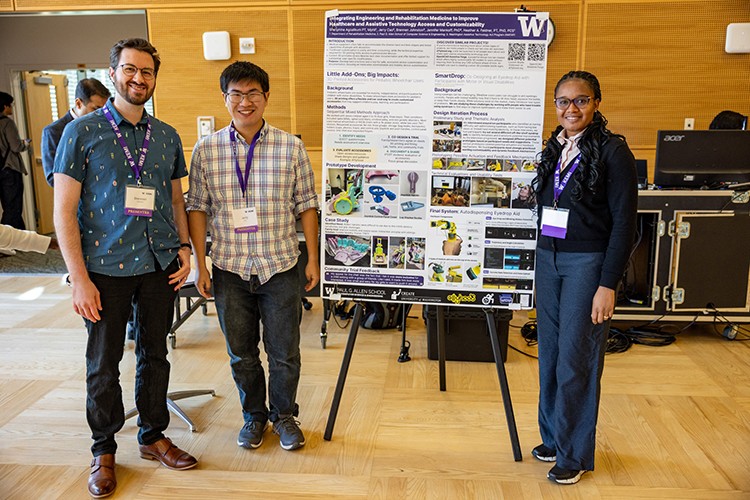
Through UW CREATE, the University of Washington’s Center for Research and Education on Accessible Technology and Experiences, I contribute to Integrating Engineering and Rehabilitation Medicine to Improve Healthcare and Assistive Technology Access and Customizability, a project funded by the Kren Engineering-based Medicine Initiative (KEMi) and led by Jennifer Mankoff with Heather Feldner.
My focus in it is accessible documentation standards for DIY and 3D-printed assistive technology, so open designs are easier to share, reproduce, and adapt by the people who need them. Related efforts and repositories are gathered at a11yhood.org.
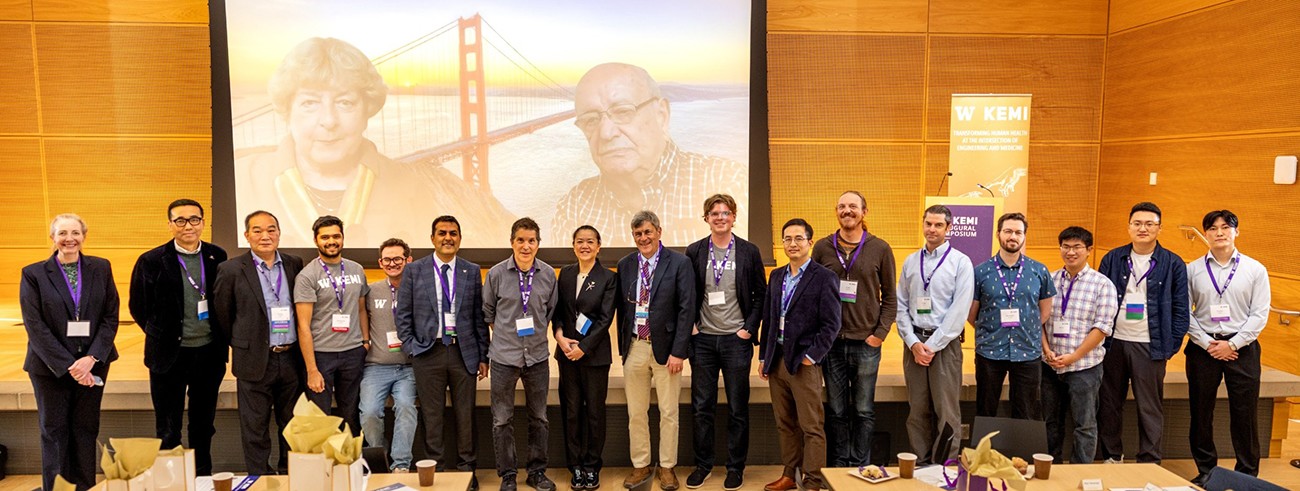
KEMi held its inaugural symposium on October 22, 2026, at the Husky Union Building, with more than 240 attendees from universities, hospitals, research institutes and industry across the Pacific Northwest. Our project was among the posters presented that afternoon, and I was there for the day; I appear in two of the event photographs on that page.
HuskyADAPT
HuskyADAPT is the University of Washington student organization for accessible design and inclusive play, and it houses Washington’s GoBabyGo! program. HuskyADAPT hosted much of the hackathon work behind the OpenSCAD Assistive Forge and its Charm Designer.
WOOF3D
WOOF3D is the University of Washington’s student 3D printing club and has been a remarkable partner. Over the last year they have worked through every custom assistive technology request I’ve sent them, and then some, which is what makes it possible for a request not to sit waiting on one person’s schedule.
The Charm Designer is directly descended from a WOOF3D student design, and the OpenSCAD Assistive Forge grew out of it.
Makers Making Change and TOM
Local capacity only goes so far, so I also work to connect Washington’s maker groups to the wider networks: Makers Making Change across North America and TOM (Tikkun Olam Makers) globally. The guides for the Custom Braille Card Embosser V2 and the Parametric Plug Puller follow the Makers Making Change Open AT (open assistive technology) documentation template.
Hackathons
Two hackathons shaped the tools on this site more than anything else:
- The Adaptive Solutions Mini-Hackathon, run with UW CREATE, HuskyADAPT, and the King County Library System.
- The GitHub Open Source Assistive Technology Hackathon, whose project collection is on GitHub.
Both are where a single charm request turned into a general-purpose web front end for OpenSCAD assistive design tools.
Contributors
- Nasif Zaman wrote the OpenSCAD charm generator that the Charm Designer runs on.
- Duy Do (UW WOOF3D) created the original AAC (augmentative and alternative communication) charm design that started the whole line of work.
- Daniel K., a paraeducator working in audiology and assistive technology, built the task-list charm bracelet documented on the Charm Designer page and shared the photos for public use.
Working together
If you are a maker group, clinician, researcher, or someone who uses assistive technology and wants to test or adapt something here, the fastest way in is to comment on the model pages linked from any project, or to open an issue on GitHub. Prototypes are shared early on purpose: real feedback from users, clinicians, and makers is what turns a rough prototype into a device that actually works for people.